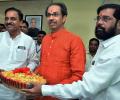
The Supreme Court is deliberating whether a split in the Shiv Sena could originate in the legislature party and then extend to the broader organisation and primary membership, as it hears pleas from the Uddhav Thackeray faction challenging the Election Commission's recognition of the Eknath Shinde-led faction.
The Supreme Court, in a 6:3 majority verdict, has ruled that the expansive, labour-friendly definition of 'industry' from its 1978 Bangalore Water Supply and Sewerage Board judgement will not be used for interpreting the Industrial Relations Code of 2020. However, the 'triple test' from the 1978 verdict will still apply to pending cases under the now-repealed 1947 Industrial Disputes Act.

The Uddhav Thackeray faction has told the Supreme Court that the Election Commission's decision to recognise the Eknath Shinde-led unit as the "real Shiv Sena" and grant it the 'bow-and-arrow' symbol was unlawful. Senior advocate Kapil Sibal argued that a split in a legislature party cannot, by itself, amount to a split in the political party, challenging the very basis of the poll panel's jurisdiction and its disregard for the party's 2018 constitution.

The Supreme Court has urged the CBSE to reconsider the implementation of its three-language policy for Class 9 students, emphasising that children should not be subjected to undue pressure. The court highlighted concerns about infrastructure, the starting point of the policy, and the definition of 'native' languages.

The Supreme Court has quashed all FIRs against students who participated in the Cockroach Janta Party-led protests, stating the cases should not affect their future, while the government affirmed its commitment to youth welfare.

Chief Justice of India Surya Kant sharply criticised the Bar Council of India (BCI) for its 'uncalled for' interference in a protest by NALSAR University of Law students, asserting that students have a right to protest and that the matter was a 'dialogue between students and me'. The BCI had initially ordered that 2026 NALSAR graduates not be enrolled as advocates, an order it later reversed.
In a landmark decision, the Supreme Court of India has quashed the 2021 Office Memorandum allowing retrospective environmental clearances, reinforcing the importance of prior environmental approval for projects but held that the judgment will apply prospectively, thus saving projects that got retrospective ECs from demolition and other punitive measures.

The Supreme Court has directed the Uttar Pradesh government's Special Investigation Team (SIT) to submit a status report on the alleged embezzlement of donation money at the Ram temple in Ayodhya. The court also issued notice to the Shri Ram Janmabhoomi Teerth Kshetra Trust following pleas for a fair and time-bound probe, including demands for a CBI investigation and a CAG audit of the temple trust's finances.

The Supreme Court has stressed the importance of law enforcement agencies exercising restraint during protests, advocating for the pacification and counselling of youngsters, even if some engage in stone-pelting, as it agreed to hear a plea regarding accountability for protest organisers.
The Supreme Court has directed all states and Union territories to provide comprehensive information on acid attack cases, including case status, victim details, and rehabilitation measures.

The Supreme Court has granted Trinamool Congress MP Abhishek Banerjee permission to travel abroad for three weeks for eye treatment, dismissing the West Bengal government's concerns about his return due to 16 pending cases.

The Supreme Court has questioned the amended constitution of the Shiv Sena, observing that it appeared to have made the party 'virtually a one-person structure' and raising concerns about democratic functioning within political parties.

The Supreme Court asserted that the right to peaceful protest is 'absolutely guaranteed' and an agitation cannot justify 'police excesses' or a 'lathi charge,' while agreeing to hear pleas concerning alleged police brutality against students protesting the NEET paper leak.

Retiring Supreme Court Justice Sanjay Karol stated in his farewell address that judges are not gods and will not get every judgement right, emphasising the need for humility and the ability to see the real person behind every litigant.

The Supreme Court has agreed to urgently hear the bail plea of advocate Surendra Gadling, who has been incarcerated for seven-and-a-half years in the 2018 Elgar Parishad-Maoist links case, with the hearing scheduled for next week.
The Supreme Court has agreed to constitute a special bench to address the Centre's plea regarding the applicability of its March 11 judgment on OBC creamy-layer criteria to candidates of the Civil Services Examination (CSE) 2025. The Department of Personnel and Training (DoPT) seeks to proceed with service allocation for 958 recommended candidates based on the creamy-layer determination applied before the verdict, citing potential unequal treatment and disruption to training schedules.

The Supreme Court has allowed former West Bengal chief minister Mamata Banerjee and others to file fresh applications regarding their claim that victory margins were less than the deletion of votes during the Special Intensive Revision of electoral rolls.

The Supreme Court has established a five-member high-powered committee, led by former top court judge Justice R Subhash Reddy, to investigate allegations of police excesses against student protesters and violence against police personnel during recent demonstrations in Delhi.

The Supreme Court has stated that a complete ban on pellet guns is not possible as long as existing advisories permit their use for crowd control in exceptional circumstances by security agencies. However, the court clarified that allegations of specific misuse can be examined on a case-by-case basis, particularly in light of recent protests against the NEET paper leak.

The observations came from a bench of Chief Justice Surya Kant and Justice Joymalya Bagchi which was hearing pleas questioning the validity of Section 152 of the Bharatiya Nyaya Sanhita (BNS).
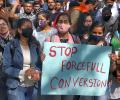
The Supreme Court has agreed to hear a plea challenging the validity of the Rajasthan Prohibition of Unlawful Conversion of Religion Act, 2025, potentially impacting religious freedom and state legislation.
The Supreme Court of India refused to entertain a petition from a judicial officer challenging the recommendation of junior officers for appointment as Himachal Pradesh High Court judges. The court stated it would not "open a pandora's box" by judicially reviewing collegium proceedings, emphasising the collegium's subjective satisfaction in such matters. The petitioner later withdrew his plea to pursue administrative or judicial remedies at the High Court level.

The Supreme Court has sought the Centre's response on a petition challenging the constitutional validity of polygamy among Muslims, arguing it violates fundamental rights and creates legal asymmetry by exempting Muslim men from bigamy laws applicable to other citizens.

The Supreme Court has directed the Reserve Bank of India to prepare a standard operating procedure (SOP) within four weeks to deal with bank accounts linked to cyber frauds, including mule accounts. This directive is part of a broader effort to strengthen responses to cyber-enabled financial frauds, with the court also urging states and UTs to adopt and operationalise grievance redressal and money restoration modules.

The Supreme Court was strongly urged to establish a Special Investigation Team (SIT) led by a former judge to investigate alleged police excesses against students protesting the NEET paper leak across various states. The court, while issuing interim directions, restrained states from coercive action against protesters and ordered the release of minors without criminal antecedents.

The Supreme Court of India has strongly criticised comedian Samay Raina and YouTubers Ranveer Allahbadia and Ashish Chanchlani for failing to comply with its previous order regarding disability awareness. The court expressed dismay over Raina's non-compliance and his alleged insensitive remarks about persons with disabilities, urging the Centre to consider a stringent law against such derogatory comments.

The Supreme Court on Monday asked the Uttar Pradesh government to apprise it about the possibility of setting up an SIT to probe the alleged embezzlement of donations at the Ram temple in Ayodhya and cautioned the litigants not to politicise the issue.

The Supreme Court of India has refused an urgent hearing on a plea seeking an investigation into allegations concerning fake advocates and the activities of the satirical digital outfit 'Cockroach Janta Party' (CJP), with the Chief Justice advising the petitioner not to take the issue 'so sentimentally'.

The Supreme Court has allowed former West Bengal chief minister Mamata Banerjee and others to file fresh applications regarding their claim that victory margins in 31 constituencies in the recent assembly polls were less than the deletion of votes during the Special Intensive Revision (SIR) of electoral rolls.

The Supreme Court is set to hear a batch of petitions on July 13 seeking a fair and time-bound probe into the alleged embezzlement of donations at the Ram temple in Ayodhya, with petitioners requesting a CBI investigation and a CAG audit of the temple trust's finances.

The Cockroach Janta Party (CJP) on Tuesday accused the Centre of resisting the Supreme Court's bid to facilitate quashing of FIRs against students and protesters and demanded that the outfit's members be included in the high-powered committee announced by the court to examine allegations of police excesses and violence against cops.
The Supreme Court has clarified that 'criminal antecedents' for NEET paper leak protesters refer only to grave and heinous offences, allowing state governments to withdraw FIRs against students not involved in such serious crimes. This comes after the Centre's commitment to not pursue cases against most protesting students.
The Supreme Court has expressed disappointment over the delay in the Lakhimpur Kheri violence case trial due to the non-production of witnesses, directing the presiding judge to ensure their presence and expedite the proceedings.

The Supreme Court granted bail to Suhail Ahmad Thokar, arrested under UAPA for allegedly conspiring with terrorist groups to recruit terrorists and radicalise youth after the repeal of Article 370.
The Supreme Court has scheduled a hearing for June 29 on a public interest litigation (PIL) seeking the registration of an FIR and a time-bound probe into the alleged embezzlement of donations received by the Shri Ram Janmbhoomi Teerth Kshetra Trust in Ayodhya.

The Supreme Court has dismissed a plea from a Dubai-based businessman seeking consolidation of 24 criminal cases against him, emphasising the need for a victim-centric judicial approach.

Chief Justice of India (CJI) Surya Kant likened some unemployed youngsters to cockroaches, saying they become media, social media, and RTI activists and attack the system. The comments were made while hearing a petition from a lawyer seeking senior advocate designation.
The Supreme Court has modified its previous order regarding three academics involved in a controversial NCERT textbook chapter on corruption in the judiciary, allowing government bodies to make independent decisions about their association with the academics.
The Supreme Court has asked the media to exercise restraint while reporting developments in the death of former model-turned-actor Twisha Sharma, observing that it was pained by the handling of the case.
The Supreme Court has emphasised that the expert committee tasked with defining the Aravalli hills and ranges must consult domain experts and other stakeholders to ensure public input is heard.
